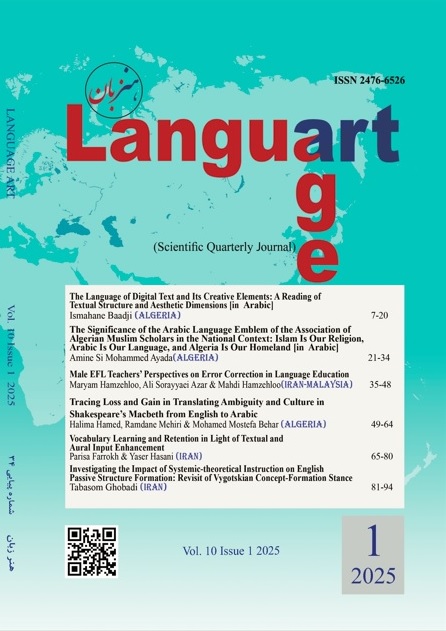
The Language of Digital Text and Its Creative Elements: A Reading of Textual Structure and Aesthetic Dimensions
DOI:
https://doi.org/10.22046/LA.2025.01Keywords:
Structure, Language, Interactive Media, Digital Text, Creator, Recipient, Aesthetics of ReceptionAbstract
This research examines the concept of digital text and its linguistic/structural characteristics, offering a comprehensive vision of this new form of literary creativity. It highlights features that distinguish digital texts from traditional ones, such as their interactive structure and dynamic language shaped by digital interfaces. The study also analyzes the creative process, explaining how digital media transform text production/reception and introduce new aesthetic dimensions to the reading experience. Furthermore, the paper reviews key definitions of digital text proposed by scholars, exploring diverse perspectives to deconstruct the concept. It discusses how traditional literary theories have been compelled to rethink core notions like text, author, and reader due to rapid technological advancements, which have spurred new modes of literary communication and reader interaction. The research also investigates the relationship between digital text and reception aesthetics, demonstrating how interactive media redefine the reader’s role—from a passive consumer to an active co-creator of the text. Finally, it addresses critical challenges, including: Preserving textual authenticity, Evolving authorship/reception dynamics, And theoretical gaps in analyzing this literary form.
References
إبراهيم،أ. م. (2013). الأدب والتقنية مدخل إلى النقد التفاعلي. دار عالم الكتب الحديث.
حمداوي، ج. (2016). الأدب الرقمي (ط1)، شبكة الألوكة، المغرب.
زنینة. كـ. (2009). النص الأدبي من الشفهیة إلى الرقمیة رؤیة في المفهوم والمرجعیة والآفاق النقدیة، مذكرة مقدمة لنیل شهادة الماجستیر إشراف الأستاذ: عبد الملك بومنجل، جامعة سطیف 2، قسم اللغة العربیة وآدابها.
الصفراني، م. (2008). التشكيل البصري في الشعر العربي الحديث. النادي الأدبي. الرياض.
يقطين، س. (2005). من النص إلى النص المترابط –مدخل إلى جماليات الإبداع التفاعلي. المركز الثقافي العربي. المغرب.
زعلة، ع، أ. (2019). النص الرقمي بین الإنتاج والتلقي- قراءة في التشكیل الجمالي والدلالي. المؤتمر الدولي الخامس للغة العربية.
البریكي ، ف. (2006). مدخل إلى الأدب التفاعلي. المركز الثقافي العربي. المغرب.
يخلف، ف. (2013). الأدب الإلكتروني وسجالات النقد المعاصر، مجلة المخبر، أبحاث في اللغة والأدب الجزائري، جامعة بسكرة، الجزائر، العدد التاسع.
References
Aarseth, E. J. (1997). Cybertext: Perspectives on Ergodic Literature. Johns Hopkins University Press.
Al-Buraiki, F. (2006). Madkhal ila al-adab al-tafa'uli [Introduction to interactive literature]. Al-Markaz al-Thaqafi al-'Arabi.
Al-Safrani, M. (2008). Al-tashkil al-basari fi al-shi'r al-'arabi al-hadith [Visual formation in modern Arabic poetry]. Al-Nadi al-Adabi.
Bolter, J. D. (2001). Writing Space Computers, Hypertext, and the Remediation of Print. Routledge. USA.
Douglas, Y. J. (2000). The End of Books – Or Books Without End? Reading Interactive Narratives. University of Michigan Press. USA.
Eskelinen, M. (2012). Cybertext Poetics: The Critical Landscape of New Media Literary Theory. Continuum.
Hamdawi, J. (2016). Al-adab al-raqmi [Digital literature]. Shabakat al-Alukah.
Hayles, N. K. (2008). Electronic Literature: New Horizons for the Literary. University of Notre Dame Press.
Ibrahim, A. M. (2013). Al-adab wa-al-tiqniyah: Madkhal ila al-naqd al-tafa'uli [Literature and technology: An introduction to interactive criticism]. Dar Alam al-Kutub al-Hadithah.
Isère, W. (1980). The Act of Reading: A Theory of Aesthetic Response. Johns Hopkins University Press.
Kaufmann, W. (2013). Digital Literature: A New Literary Genre.
Kristeva, J. (1980). Desire in Language: A Semiotic Approach to Literature and Art. Tra: Gora, T, Roudiez, L, S. Columbia University Press. USA.
Landow, G. (2006). Hypertext 3.0: Critical Theory and New Media in an Era of Globalization. The Johns Hopkins University Press. USA.
Yakhlif, F. (2013). Al-adab al-iliktroni wa-sajalat al-naqd al-mu'asir [Electronic literature and contemporary critical debates]. Majallat al-Mukhabbar: Abhath fi al-Lughah wa-al-Adab al-Jaza'iri (asjp), 9, University of Biskra.
Yaqtin, S. (2005). Min al-nass ila al-nass al-mutarabit: Madkhal ila jamaliyat al-ibda' al-tafa'uli [From text to hypertext: An introduction to the aesthetics of interactive creativity]. Al-Markaz al-Thaqafi al-'Arabi.
Za'lah, A. A. (2019). Al-nass al-raqmi bayna al-intaj wa-al-talaqqi: Qira'a fi al-tashkil al-jamali wa-al-dalali [The digital text between production and reception: A reading of aesthetic and semantic formation]. Al-Mu'tamar al-Dawli al-Khamis li-Lughat al-'Arabiyya [5th International Conference on Arabic Language].
Zanina, K. (2009). Al-nass al-adabi min al-shafahiya ila al-raqmiya: Ru'ya fi al-mafhum wa-al-marja'iya wa-al-afaq al-naqdiyya [The literary text from orality to digital: A vision of concept, reference, and critical horizons]. Master’s thesis, University of Setif 2.
Downloads
Published
How to Cite
Issue
Section
License
Copyright (c) 2025 Ismahane Baadji

This work is licensed under a Creative Commons Attribution 4.0 International License.